A Designer’s Review of the Nurse Retirement Schedule SVG
When a design file lands in my project folder, I approach it not just as a graphic, but as a blueprint for a finished product. My immediate question is always: how will this translate into stitches? Today, I’m looking at the Nurse Retirement Schedule SVG, a design described simply as great for mugs and t-shirts. From that brief note, I’m already thinking about its potential beyond those two surfaces, and how it might perform across the spectrum of projects my clients and my own small shop demand.
First Impressions: A Design Built for Warm Recognition
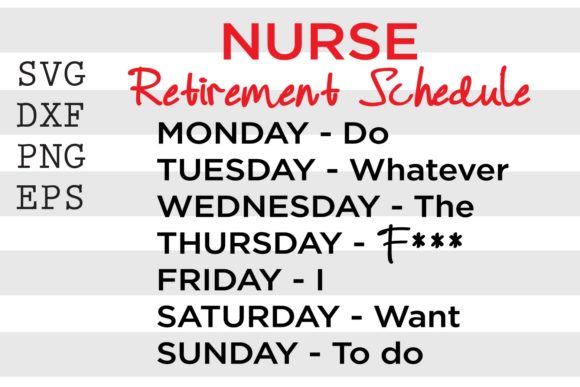
Opening this SVG, the theme is immediately clear and heartfelt. It speaks to a significant career milestone with a tone that feels celebratory and respectfully professional. The layout, centered around a schedule, suggests a narrative—a story of dedication and service. The level of detail appears intentional, avoiding overly intricate flourishes that could become muddy in embroidery. This gives it a visual personality that is clean, meaningful, and gift-ready. It doesn’t scream; it announces with quiet pride. My first thought is that this design belongs naturally to projects meant for honoring someone: a custom embroidered tote bag for a retiring colleague, a personalized sweatshirt for a family member, or a commemorative apron for a department celebration.
The Real Embroidery Test: Where This Design Shines
In practical embroidery situations, the strength of a design lies in its adaptability. While the product description mentions mugs and t-shirts—both excellent starting points—the true test is how it scales and transfers.
For custom apparel like t-shirts and sweatshirts, the design’s likely moderate detail level is a plus. On a polo shirt or a hoodie, it could become a centerpiece. On a baby’s item or a delicate blanket, it might need scaling down, but the theme could adapt beautifully for a nurse’s grandchild. As an embroidered patch, it would be superb, easily appliquéd onto a bag or a cap. For home decor like pillow covers or tea towels, it introduces a personal, story-driven element. As a holiday gift or wedding gift for a nurse, it transcends generic presents. For small business merchandise or Etsy listings, this SVG provides a ready-made asset for a niche audience—crafters targeting the healthcare community.
Thinking Like a Customer: The Finished Product Appeal
When I stitch a design, I’m also visualizing the customer’s reaction. The Nurse Retirement Schedule SVG, when embroidered cleanly, boosts visual appeal through its thematic clarity. The stitching clarity will depend on handling the text elements—small lettering can be tricky. A well-executed version on, say, a heavyweight tote bag, immediately enhances product value and customer trust. It feels like a handmade presentation with thought behind it. For a creative entrepreneur, using such a design consistently for nurse-themed products can build brand consistency. Its inherent giftability and professional recognition are its biggest commercial strengths.
Caution Zones: Where to Be a Careful Designer
Every design has its careful-use cases. With this one, I’d be particularly mindful on small hoop sizes. If the schedule text is finely rendered, shrinking it too much for a hat or a small patch could lead to lost detail. Textured fabrics like some linens might obscure the cleaner lines. On thin or stretchy fabric without proper stabilizer, the stitch density (which I’d need to check in the actual embroidery file) could cause puckering.
Embroidering on dark fabric requires thoughtful thread color contrast planning—a test on scrap fabric is essential. Curved surfaces like caps demand perfect stabilization and possibly a simplified version. Those potential detailed corners or tiny lettering in the schedule need scrutiny in a test run. For products that need frequent washing, like kitchen towels or aprons, ensuring the stitch coverage is robust and secure is key to longevity.
Practical Notes from the Hoop
Before committing this Nurse Retirement Schedule SVG to a client project or my shop inventory, my process would be straightforward:
- Test the design on scrap fabric first. This is non-negotiable. It reveals the true behavior of the satin stitches, fill stitches, or running stitches.
- Check thread color contrast against both light and dark fabric backgrounds. Sometimes a design needs a slight color shift to pop.
- Review stitch density in the actual embroidery file to gauge the best fabric texture to use.
- Confirm hoop size requirements and how the design scales up and down.
- Inspect small details by stitching a sample. Are the smallest elements readable?
- Test it in black and white mockups as well, to see the form without color.
- Use proper stabilizer for the chosen project—this can make or break the outcome.
- Crucially, check whether the design works for both personal and commercial projects, and confirm licensing before selling finished items or digital products. The description doesn’t specify this, so that verification is a mandatory step.
This SVG, as a digital embroidery file, is a craft business asset. Its value is unlocked by this practical pre-work.
The Final Stitch: A Design with Clear Purpose
In my judgment, the Nurse Retirement Schedule SVG is a design with a strong, specific purpose. It’s not a generic graphic; it’s a targeted storytelling tool. Its mood is appreciative and dignified. In real embroidery projects—from a custom apparel gift to a small shop product for a craft fair—it can translate into a deeply resonant finished product. Its success hinges on treating it not just as a graphics file in the crafts category, but as a physical embroidery blueprint. Handle the details with care, choose the right project canvas, and it will stitch up into something that feels both professionally made and personally meaningful. That’s the sweet spot for any designer or maker.